
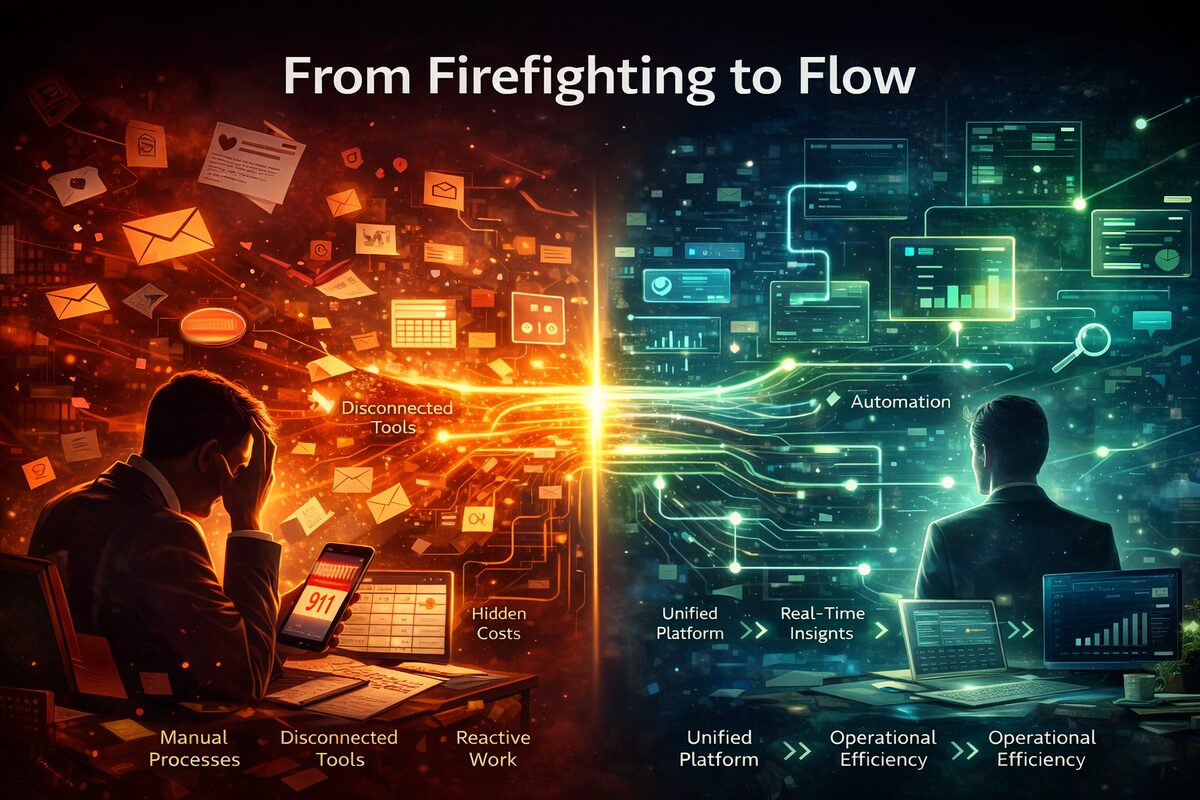
Have you ever received a 911 call from your CRO after hours not so politely asking you why the customer is not onboarded yet? How this is causing us to miss revenue in the quarter? If this has happened to you as a VP of Delivery or COO, you have likely spent countless hours calling your delivery team, finance and sales to figure out where the bottleneck is, only to find out somehow a process step was missed by the CRO’s team. Poor assumptions, hours wasted, revenue delayed, and unnecessary costs incurred due to a lack of visibility and transparency across point solutions in the enterprise.
As a former CTO ultimately responsible for customer and user experience, customer support and delivery operations across all product lines, I was living this and our business was distracted fire fighting — but we found a better way. The costly emergency 911 calls stopped, the visibility and transparency increased. A digital transformation strategy and workflow layer across the enterprise was the game-changer. This streamlined order to cash, improved customer experience and retention, and removed unnecessary costs that were caused by process friction.
Disjointed point solutions were impacting our business
With over 1,000 SMB managed service customers, like any other managed service provider, we were measured on customer retention, customer experience, SLAs, and team profitability. In this competitive MSP market, whoever can provide the best experience for the lowest cost wins.
We had grown through acquisition of many boutique MSPs, all with their own customers, process and tools to support them. We inherited too many duplicate and non-integrated solutions in the process. Getting metrics across these solutions that did not talk to each other to justify the metrics we were being measured on was next to impossible. Getting economies was non-existent. Duplication of roles and teams meant we would struggle to achieve the margins required to grow the business.
Many other MSPs have this same struggle. We were not alone. But we knew in order to be competitive and to be able to scale and retain customers, we needed to bite the bullet and change.
Getting rid of the friction across business teams
As sales suffered taking care of firefighting and complaints, finance were challenged to show where costs and the profits were going, and delivery was feeling the pain of the customer on the front line. Friction across business teams increases and finger pointing begins. Meanwhile you are losing as many customers as you are winning, and the company culture is suffering.
At the root of this is siloed process and point solutions all trying to fix the problem. All designed from the inside out, and to serve one business function and further adding fuel to the friction fire.
So what did we do to fix this? We realized process was always meant to be designed from the outside in, with the experience in mind, not one person’s role in the company. Without happy customers or employees (outside view), individuals in charge of digital transformation for the company were designing inside out, from the role or department perspective. Sure, this would help a team or individual become a little more efficient, but it did not address the root of the problem nor did it help with customer retention or CSAT scores — or at least not enough.
We had to listen to the teams and individuals doing the fire fighting and actually talking to the customers and employees. We had consensus that process is not siloed, but actually flows across every corner of your business and across enterprise teams. We began to understand the broken process and where the friction was coming from the perspective of the recipient of that process or service and not the provider of it.
In order to remove the friction as process went across business teams impacting the customer and employee, we needed to find a solution that could improve the customer and employee experience as process flowed from business team to business team.
Say goodbye, almost, to process friction
A unified digital workflow platform across business silos became the game changer for us. Customer retention and satisfaction increased, the 911 after hours calls from team to team mostly went away, replaced by transparency and efficiency on the process across business teams. Sales could focus on new revenue for the business. The gaps and delays in the order to cash processes were reduced and mostly removed, employee retention and morale improved.
We chose to break down these barriers across business teams by providing a unified approach to service delivery. These are the benefits of having a unified digital transformation platform:
-
Improved Efficiency and Speed: Automating workflows and standardizing processes reduced manual tasks, errors and bottlenecks, accelerating time to deliver and fulfill on customer and employee requests and needs.
-
Enhanced Customer Experience: Faster customer onboarding and support response times; consistent service quality and improved customer satisfaction.
-
Cost Savings: Streamlined and removal of process friction across operations lead to reduced operational costs.
-
Scalability: We scaled the unified platform across Sales, Finance, and Delivery teams through Customer Support, Customer Delivery, HR Service Delivery, Employee Request and Customer Invoicing. Future initiatives included CRM, Quoting, and Financial Operations.
Keys to success
Implementing a successful digital strategy requires careful planning and execution. Below are the key components to consider.
Leadership Buy-In
Gaining support from senior leadership, especially from the CEO, is crucial. This needs to span across work teams and cannot be owned by one team. Communication from the leaders of the benefits and how it aligns with organizational goals is imperative.
Clear Objectives
Define clear objectives and goals like: improved customer retention, improved cost and profit transparency, improved employee retention and satisfaction.
Technology Selection
Choose a platform that meets your organization’s needs and does not just focus on one business team’s needs. Look for features like automation for speed and simplicity, integration capabilities to flow into and out of back office solutions, and user-friendly digital interfaces and AI-enabled workflows.
Employee Training
Provide comprehensive training and organizational change management to ensure employees understand how to use the platform effectively.
Continuous Improvement
Regularly review and optimize processes to adapt to changing business needs.
Conclusion
Can digital transformation really accelerate your business operations while reducing costs and returning ROI? It absolutely can — I lived it. However, like many other failed digital transformation projects, designing inside-out vs. outside-in from the customer’s or employee perspective, not having CEO buy-in, and not addressing the process friction across business teams are the pitfalls to avoid.
Digital transformation is more than just a tool — it’s a strategic approach to enhancing operational efficiency and delivering exceptional experiences to your customers and employees. Talk to us about how SageX Transformations helps organizations implement great digital experiences.